




Undergraduate Course
FdA Therapeutic Communication and Therapeutic Organisations

Overview
The details
Therapeutic Communication and Therapeutic Organisations
LX51
October 2026
Full-time
What is FdA Therapeutic Communication and Therapeutic Organisations?
This is an online version of our FDA Therapeutic Communication and Therapeutic Organisations. This course is taught through distance learning meaning the entire two years of the course is taught online with no face-to-face, in-person teaching. You will graduate with the same qualification as our campus based FDA, the only difference being you will attend all teaching virtually and not on campus.
This Foundation Degree is designed for people who want to develop therapeutic and psychodynamic skills to support children, young people, and adults in care, education, and support settings.
Delivered one afternoon per week, the course combines academic learning with practical insight to help you develop as a reflective and effective practitioner.
There is also a campus based version of this course available for those who wish to study in person.
Why this course
This course helps you explore key questions about care and support practice, including how to best support people in need, how to work collaboratively with colleagues, and what constitutes effective therapeutic support across different age groups.
Using a psychodynamic framework, you will develop an understanding of emotional and relational processes within individuals, as well as the wider organisational dynamics that shape care environments.
By combining theory with workplace experience, the course supports your development as a reflective practitioner capable of understanding both individual needs and systemic influences.
Who should apply
- Those working or aiming to work in education, health, or social care settings
- Practitioners seeking to develop therapeutic and psychodynamic skills
- Learners interested in understanding behaviour, relationships, and organisational dynamics
- Professionals looking to enhance reflective practice and communication skills
What you’ll learn
- Psychodynamic theory: Understand core concepts of psychodynamic thinking and practice
- Human development: Study child and adult development across care and support contexts
- Trauma and violence: Explore the impact of trauma, violence, and emotional distress
- Therapeutic organisations: Examine how organisational dynamics influence care and support work
Your learning experience
- Part-time study: One afternoon of teaching per week designed to fit around work and practice
- Reflective workshops: Develop insight as a reflective practitioner through structured observation and reflection
- Workplace learning: Connect academic learning directly with your professional practice
- Applied approach: Focus on real-world therapeutic communication and organisational understanding
- Progression route: After completion, progress to a one-year top-up course to achieve a BA Honours degree
Careers and outcomes
This Foundation Degree supports career development in therapeutic and care-focused roles across a range of settings:
- Health and social care: Roles supporting children, young people, and adults in care settings
- Education and support services: Working in schools, community services, and support organisations
- Therapeutic practice: Supporting emotionally informed and psychodynamic approaches to care
- Organisational development: Improving communication and relational dynamics in professional settings
Employers of graduates from this course
Graduates typically work in roles across care, education, and therapeutic organisations, including:
- Social care providers and community services
- Schools and educational support services
- Mental health and wellbeing organisations
- Charities and third-sector support organisations
- Healthcare and therapeutic service providers
Why we're great.
- Our course tutors are experienced practitioners, who have worked with children and adults facing challenging circumstances, over many years.
- The course gives you the concepts, tools and support to develop your therapeutic work, and at the same time, you can continue progressing with your career.
- Build your reputation and profile in existing roles in social work, healthcare, mental health, community work and education.

Course content
Course structure
We offer a flexible course structure with a mixture of core/compulsory modules, and optional modules chosen from lists.
Our research-led teaching is continually evolving to address the latest challenges and breakthroughs in the field. The course content is therefore reviewed on an annual basis to ensure our courses remain up-to-date so modules listed are subject to change.
Please note that in both years, you choose between two modules - Theory, Practice and Responsibility (Child and Adolescent) and Theory, Practice and Responsibility (Adult) - depending on your preferred route.
Components and modules explained
Components
Components are the blocks of study that make up your course. A component may have a set module which you must study, or a number of modules from which you can choose.
Each component has a status and carries a certain number of credits towards your qualification.
| Status | What this means |
| Core |
You must take the set module for this component and you must pass. No failure can be permitted. |
| Core with Options |
You can choose which module to study from the available options for this component but you must pass. No failure can be permitted. |
| Compulsory |
You must take the set module for this component. There may be limited opportunities to continue on the course/be eligible for the qualification if you fail. |
| Compulsory with Options |
You can choose which module to study from the available options for this component. There may be limited opportunities to continue on the course/be eligible for the qualification if you fail. |
| Optional |
You can choose which module to study from the available options for this component. There may be limited opportunities to continue on the course/be eligible for the qualification if you fail. |
The modules that are available for you to choose for each component will depend on several factors, including which modules you have chosen for other components, which modules you have completed in previous years of your course, and which term the module is taught in.
Modules
Modules are the individual units of study for your course. Each module has its own set of learning outcomes and assessment criteria and also carries a certain number of credits.
In most cases you will study one module per component, but in some cases you may need to study more than one module. For example, a 30-credit component may comprise of either one 30-credit module, or two 15-credit modules, depending on the options available.
Modules may be taught at different times of the year and by a different department or school to the one your course is primarily based in. You can find this information from the module code. For example, the module code HR100-4-FY means:
| HR | 100 | 4 | FY |
|---|---|---|---|
|
The department or school the module will be taught by. In this example, the module would be taught by the Department of History. |
The module number. |
The UK academic level of the module. A standard undergraduate course will comprise of level 4, 5 and 6 modules - increasing as you progress through the course. A standard postgraduate taught course will comprise of level 7 modules. A postgraduate research degree is a level 8 qualification. |
The term the module will be taught in.
|
COMPONENT 01: CORE
Becoming Human
(30 CREDITS)
How do unconscious dynamics work in individuals, groups and organisations? How can psychodynamic insight be applied to this? Explore how individuals affect one another, how institutions affect those who work there and vice versa. Understand key concepts in psychodynamic thinking and how to apply this to individuals, groups and workplaces.
COMPONENT 02: CORE
Introduction to Psychodynamic Observation and Reflective Practice
(30 CREDITS)
How do you apply psychodynamic theory to everyday events? What role does the unconscious play in ordinary life? Gain a theoretical and practice-based understanding of psychodynamic observation. Develop practical skills in assessment and case presentation, while becoming more perceptive and reflective of what you observe.
View Introduction to Psychodynamic Observation and Reflective Practice on our Module Directory
COMPONENT 03: CORE
Work-based Learning 1
(30 CREDITS)
Want to work independently? Keen to learn through practice? Continue your normal work responsibilities and individual casework while receiving expert supervision. Learn to communicate and work effectively in an institutional setting. Take this opportunity to discuss your overall work experience with aspects of your degree scheme in mind.
COMPONENT 04: COMPULSORY
Theory, Practice and Responsibility
(30 CREDITS)
What are the complexities of human relationships? You will learn and explore different topics, linking relevant theories to clinical observation and connecting them with your work-based practice. Each week you will explore a different topic, through peer-reviewed articles, case studies, anecdotes from professional sources and first-hand DVD diaries of looked after children.
View Theory, Practice and Responsibility on our Module Directory
COMPONENT 01: COMPULSORY
PA223-5-AT
(15 CREDITS)
COMPONENT 02: CORE
PA224-5-AP
(30 CREDITS)
COMPONENT 03: COMPULSORY
PA225-5-PT
(15 CREDITS)
COMPONENT 04: CORE
PA220-5-AP
(30 CREDITS)
COMPONENT 05: COMPULSORY
PA121-5-PT
(15 CREDITS)
COMPONENT 06: COMPULSORY
PA133-5-PT
(15 CREDITS)
Teaching
- Undergraduate students in the Department of Psychosocial and Psychoanalytic Studies typically attend a one-hour lecture and a one-hour seminar for each module per week. There are some variations in place depending on the module.
- Teaching takes place in relatively small seminars and fora, with a focus on group discussion
- Discussion in seminars includes both discussing other peoples' work and discussing your own experiences in the workplace
Assessment
- Your grade is made up entirely of coursework marks, including essays and reflective reports
Entry requirements
Clearing entry requirements
We currently have places available in Clearing across a range of our courses with most offers expected to be made at CCD - CDD (88 - 80 UCAS tariff points) or equivalent. A complete breakdown of expected Clearing entry requirements, by course, is available on our Clearing entry requirements page.
We consider each application individually and requirements may be lower for some of our courses, so please still get in touch if your grades are below those outlined.
English language requirements
English language requirements for applicants whose first language is not English
IELTS 6.0 overall with a minimum of 5.5 in each component, or specified score in an equivalent test that we accept.
Details of English language requirements and the tests we accept for applicants who require a Student visa (excluding Nationals of Majority English Speaking Countries) can be found here
If we accept the English component of an international qualification it will be included in the academic levels listed above for the relevant countries.
Pre-sessional English courses
If you do not meet our IELTS requirements then you may be able to complete a pre-sessional English pathway that enables you to start your course without retaking IELTS.
Fees and funding
Home/UK fee
£9,790 per year
As part of your course, you’re required to undertake work-based observations and attend a conference. You may incur associated travel costs.International fee
£21,500 per year
As part of your course, you’re required to undertake work-based observations and attend a conference. You may incur associated travel costs.Fees will increase for each academic year of study.
If your course has the option to include a placement year or study abroad, and you choose to do so, you will pay the following:
Placement year
20% of your standard tuition fee for that year
Study abroad
Full year abroad
15% of your standard tuition fee for that year
Single term abroad
Standard tuition fee
Scholarships and financial support
There may be scholarships, bursaries or discounts available to help with the cost of this course.
Fees and funding guide
What's next

Open Days
Our events are a great way to find out more about studying at Essex. We run a number of Open Days throughout the year which enable you to discover what our campus has to offer. You have the chance to:
- tour our campus and accommodation
- find out answers to your questions about our courses, student finance, graduate employability, student support and more
- meet our students and staff
Check out our Visit Us pages to find out more information about booking onto one of our events. And if the dates aren’t suitable for you, feel free to book a campus tour here.

How to apply during Clearing
Once you’ve checked that we have the right course for you, applying couldn’t be simpler. Fill in our quick and easy Clearing application form with as much detail as you can. We’ll then take a look and get back to you with a decision.
If you already hold an offer from Essex
Please don't reapply through Clearing. We'll review your existing application using our Clearing entry requirements. If you're worried about meeting your offer or would like to change course, please contact our Admissions Team on ugquery@essex.ac.uk.
Interviews
We don’t require an interview for most of our courses that are available through Clearing, however there are some courses such as those in our School of Health and Social Care and East 15 Acting School where an interview (or audition) may be required. If this is something that’s required for the course you have applied for, we’ll email you with all of the details.
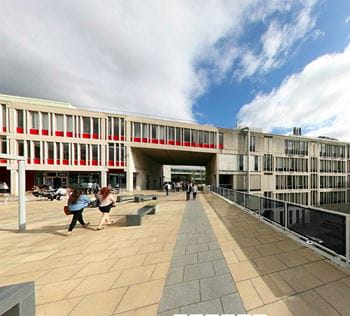
Virtual tours
If you live too far away to come to Essex (or have a busy lifestyle), no problem. Our 360-degree virtual tour allows you to explore our University from the comfort of your home. Check out our Colchester virtual tour to see accommodation options, facilities and social spaces.
At Essex we pride ourselves on being a welcoming and inclusive student community. We offer a wide range of support to individuals and groups of student members who may have specific requirements, interests or responsibilities.
The University makes every effort to ensure that this information on its programme specification is accurate and up-to-date. Exceptionally it can be necessary to make changes, for example to courses, facilities or fees. Examples of such reasons might include, but are not limited to: strikes, other industrial action, staff illness, severe weather, fire, civil commotion, riot, invasion, terrorist attack or threat of terrorist attack (whether declared or not), natural disaster, restrictions imposed by government or public authorities, epidemic or pandemic disease, failure of public utilities or transport systems or the withdrawal/reduction of funding. Changes to courses may for example consist of variations to the content and method of delivery of programmes, courses and other services, to discontinue programmes, courses and other services and to merge or combine programmes or courses. The University will endeavour to keep such changes to a minimum, and will also keep students informed appropriately by updating our programme specifications. The University would inform and engage with you if your course was to be discontinued, and would provide you with options, where appropriate, in line with our Compensation and Refund Policy.
The full Procedures, Rules and Regulations of the University governing how it operates are set out in the Charter, Statutes and Ordinances and in the University Regulations, Policy and Procedures.


Ask us a question
Want to quiz us about your course? Got a question that just needs answering? Get in touch with us on live chat!